
ROOK HEALTH

Secure Healthcare Data Integration. Connected Patient Care.

Bring your EMRs, clinical workflows, patient experiences, and intelligence together.

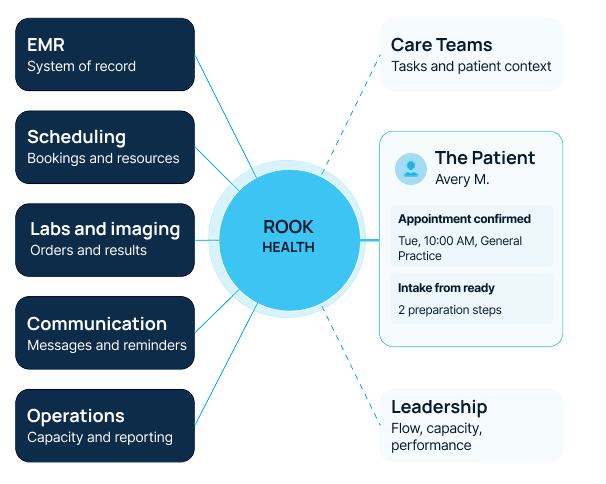
ROOK Health connects the systems your organization already relies on and coordinates the information, people, and processes around every patient. Your EMR stays the system of record. ROOK turns what it holds into coordinated action, clear responsibility, and a calmer experience for the people receiving care.

ROOK Health Connected Patient Care Integration diagram Illustrative example. Names and details are fictional.
What ROOK Health Brings Together
01

EMR Integration

Connect and extend your system of record through a governed integration layer.

02

Digital Patient Journeys

Guide patients from booking to follow-up with clear, timely information.

03

Operational Visibility

See delays, open tasks, and connection health while there is still time to act.

04

Governed AI

Put AI to work on approved information, with people reviewing every action.

05

Research Readiness

Prepare trusted, well governed data for discovery and trial feasibility.

The Connected Care Model

Turn Disconnected Healthcare Systems Into Coordinated Care

Most healthcare organizations already run capable software. The EMR holds the record, a scheduling tool books the visit, a messaging platform reaches the patient, and a reporting tool tracks performance. The trouble starts in the spaces between them.

Appointments change and the preparation instructions do not follow. Referrals arrive by fax or email and wait for someone to retype them. Follow-up tasks live in personal inboxes, so nobody can say with confidence what is still outstanding. Each gap becomes a phone call, a delay, or a patient left wondering what happens next.

ROOK starts by mapping how information really moves through your organization today. We then connect the systems involved through approved interfaces, turn important events into coordinated workflows, assign each action to the right team, and make exceptions visible the moment they occur.

Connected Care Model Comparison: Today vs With ROOK Health

Integration Mapping

We document every system, interface, and handoff before a single connection is built.

Coordinated Workflows

Important events, such as a changed appointment, start the right process automatically.

Assigned Responsibility

Every action has an owner, a due time, and a status the whole team can see.

Visible Exceptions

Problems surface as tasks instead of disappearing into an inbox.

Integration Architecture

Connect EMRs And Healthcare Applications Through A Governed Integration Layer

ROOK does not replace your EMR. It works alongside it. The EMR remains the authoritative system of record, and ROOK connects to it, along with your scheduling, communication, and operational applications, through the interfaces each vendor makes available.

Every exchange passes through a governed integration layer. Information is mapped to a consistent structure, validated before it is used, matched to the correct patient, and traced back to its source. Access is granted by role and purpose, and every exchange is monitored so problems surface quickly.

Where a system supports recognized healthcare interoperability standards, ROOK can use them. The specific standards, interfaces, and update timing for your environment are confirmed during your integration assessment.

Select a stage to see what your team receives.

01

Source Systems

Where information originates
EMR, system of record Scheduling Patient communication Operations and reporting
02

Connection Methods

Approved and controlled
Read only Write back, where approved
03

Integration Layer

Where information is checked
Data mapping Validation Patient identity matching Source traceability
04

Workflow Coordination

Where information becomes action
Workflow events Rules and approvals Assigned actions Exception handling
05

Authorized Experiences

The right view for each role
Care teams Patients Operations and leadership
03

Integration Layer

Incoming information is mapped to a consistent structure, validated for completeness, and matched to the correct patient before anyone acts on it. Every record keeps a link to its source, so a team can always see where a value came from and when.
Monitoring and oversight across every layer
Connection status Data exchange logs Workflow performance Alerts and resolution
Example: An Appointment Changes In The EMR Workflow Diagram
Going Digital

Go Digital With Workflows That Connect The Entire Practice

Going digital is more than putting a paper form online. A form is only the first step in a process that has to be collected, checked, reviewed, acted on, and closed. When everything after the submit button still runs on email and memory, the paperwork has changed but the work has not.

ROOK connects digital intake with scheduling, appointment preparation, administrative approvals, patient communication, and follow-up. Each step triggers the next, and every person can see what is waiting for them.

Software is only half of adoption. We design each workflow with the staff who will use it, train teams around the way they actually work, agree on who is accountable at every stage, and review performance after launch so the process keeps getting better.

Digital Healthcare Workflow: Before vs Coordinated Workflow

Start with one process your team handles every day. We will map it with you and show what it looks like connected.

Plan Your Digital Healthcare Workflow
The Connected Patient Journey

Connect Every Stage Of The Patient Journey

From The First Appointment To The Next Step In Care.

A patient experiences one visit. Behind it sit dozens of steps owned by different people: booking, preparation, forms, arrival, check in, finding the way, moving between services, and follow-up. When those steps are connected, the patient always knows what comes next, and the team always knows where the patient is.

ROOK pairs the patient experience with the staff workflow that supports it. Every update a patient receives reflects something the care team can see, and every action the team takes updates what the patient sees.

Connected Patient Journey Stage Interface Preview
Every Patient Included and Private Public Displays
Practices, Clinics, Hospitals, and Campuses

Coordinate Care Across Practices, Clinics, And Healthcare Campuses

Coordination becomes harder with every specialty, location, practitioner, and service provider an organization adds. A referral now crosses a building, or a company. An imaging slot depends on a consult finishing on time. A patient may see four teams in one morning, each working in its own systems.

ROOK supports a connected operating model in which scheduling dependencies, referral handoffs, resource availability, patient movement, and assigned responsibilities are coordinated across environments.

Each participating organization keeps its own boundaries. It decides what it shares, with whom, and for which purpose, and its systems and records remain its own.

Coordination Across Practices, Clinics, and Healthcare Campuses Diagram

A Growing Practice

Add practitioners and services without adding phone calls, spreadsheets, and lost handoffs.

A Network Of Clinics

Coordinate referrals and shared resources across locations while each clinic runs its own operation.

A Healthcare Campus

Plan how patients, providers, and services move together across buildings and organizations from day one.

Security and Data Governance

Secure Healthcare Connectivity Starts With Control

Define Who Can Access Information, Why They Need It, And How Its Use Is Recorded.

Connecting healthcare systems is only valuable when it is controlled. ROOK Health is designed around three questions at every step: who is asking, what are they permitted to see for this purpose, and what record remains of that access.

Controls are agreed with your privacy and security teams during implementation and documented for your environment. Compliance is a shared outcome: ROOK provides controls that support your obligations, and your policies, people, and configuration complete the picture.

The Secure Connector - Four control points on every exchange and demonstration audit trail

Identity and authentication

Every person and system is identified before access is granted, using the authentication methods agreed for your organization.

Permissions by role and purpose

Access reflects what a role needs for a specific task, not everything the system holds.

Protected data exchange

Information that crosses a system boundary is protected in transit and limited to approved fields.

Audit trails and monitoring

Access and changes are recorded, and connections are watched so failures and unusual activity reach a person quickly.

Retention and recovery

Retention periods, backup, and recovery arrangements are defined with you and documented for your deployment.

Third party access

Vendors and partners connect only through approved, scoped, and recorded access.

Security and assurance information

Request our security overview, including how controls are applied, hosting arrangements, and the assurance documentation available for review.

Governed AI

Put Healthcare AI To Work With Governed Data And Human Oversight

AI is only as useful as the information behind it. An answer built on incomplete, outdated, or unauthorized data creates more work and more risk. ROOK applies AI to information that is relevant, validated, and approved for the task at hand, inside the same permissions that govern everything else.

We focus on uses we can stand behind: finding approved information quickly, assisting with workflow steps, analyzing operational patterns, and preparing summaries for people to review. AI does not direct patient treatment, and any clinical application requires its own validation and governance.

Every output shows its sources. The reviewer can see where each statement came from, decide whether it is right, and approve, edit, or reject it within their own responsibilities. The decision and the action are recorded. Patient information does not automatically become training material for AI models.

1

A Growing Practice

Add practitioners and services without adding phone calls, spreadsheets, and lost handoffs.

2

A Network Of Clinics

Coordinate referrals and shared resources across locations while each clinic runs its own operation.

3

A Healthcare Campus

Plan how patients, providers, and services move together across buildings and organizations from day one.

4

A Network Of Clinics

Coordinate referrals and shared resources across locations while each clinic runs its own operation.

5

A Healthcare Campus

Plan how patients, providers, and services move together across buildings and organizations from day one.

Appointment preparation summary and governed AI verification workflow Demonstration interface. Names and details are fictional.
Research and Clinical Trial Readiness

Prepare Trusted Data For Research And Clinical Trial Readiness

Create a Governed Foundation for Discovery.

Research depends on data people can trust. Before the first question is asked, information has to be accurate, consistently defined, complete enough to answer the question, traceable to where it came from, and available only to the people approved to use it.

Healthcare data rarely arrives that way. The same measure is recorded differently across clinics, fields go missing, and context is lost the moment information is exported to a spreadsheet. ROOK helps organizations prepare data deliberately, starting from an approved purpose and authorized sources, with mapping, validation, standardization, and provenance tracking applied along the way.

With that foundation in place, approved data preparation can support the early and ongoing work of research, according to the capabilities and scope agreed for each project.

Feasibility assessment

Understand whether a population large enough for a study exists before committing to it.

Cohort exploration

Explore groups that share defined characteristics using prepared, approved data.

Longitudinal analysis

Follow consistent measures over time, with definitions that stay stable across sources.

Research coordination

Keep approvals, data access, and study activity organized in one governed process.

The Governed Research Data Pathway

Governance applies at every stage
01

Approved purpose and authorized sources.

A defined question, the required approvals, and named sources.

02

Data preparation

Mapping, validation, and standardization with provenance kept.

03

Privacy treatment

Controls matched to the use case and the approvals in place.

04

Controlled analysis

Two separate paths. Choose one below.

05

Output review

Results checked for accuracy and use within the approved purpose.

06

Lifecycle management

Retention, secure disposition, and a record of every access.

POPULATION LEVEL RESEARCH

Answer Approved Question Without Direct Identifiers

Prepared data is analyzed without direct identifiers to explore trends, outcomes, and feasibility. Access is limited by role and purpose, and results are reviewed before they leave the controlled environment.

Purpose limited access

Only approved researchers, only for the approved question.

Aggregate results

Findings describe groups, not individuals.

Output review

Results are checked before release for accuracy and disclosure risk.

STUDY OPERATIONS

A Controlled Link to an Individual, Only Where Permitted

Recruitment is a separate process from analysis. Where approvals allow it, a controlled link helps the authorized care team identify people who may be eligible and invite them to learn more. Trial recruitment, consent management, and study operations are offered where they are confirmed for your project.

Identify potentially eligible patients

Within the permissions and approvals for the study.

Invitation through the care team

Contact comes from people the patient already knows.

Consent and coordination

Managed under the study protocol, where confirmed in scope.

Removing names does not make data anonymous. De-identification is a structured process, assessed against the data, its context, and the risk of re-identification. Even then, it does not authorize every research use on its own. Each use still requires its own approvals.

Operational Visibility and Patient Success

Make Care Coordination And Operational Performance Visible

Connected reporting shows teams what is happening while there is still time to act: patients waiting on preparation, referrals no one has picked up, overdue follow-up, services at capacity, and integrations that have stopped exchanging data.

Each view is built around a decision and an owner. Coordinators see the work assigned to their team. Operational leaders see flow, capacity, and delays across services. Technology leaders see connection health and who is resolving each issue.

Where patient experience and outcome information is collected appropriately, it can support service evaluation and improvement over time. We interpret those measures carefully and do not promise clinical results the evidence cannot support.

Demonstration data
Operational Visibility Dashboard View
Implementation and Proof

From Healthcare Integration Strategy To Supported Delivery

Every ROOK Health engagement follows a structured path, built on the implementation method we use across the ROOK platform. Each stage ends with something concrete your team reviews and approves before the next one begins.

Your people are involved throughout. Clinical, administrative, privacy, and technology stakeholders shape the design, test the workflows, and own the result.

Select a stage to see what your team receives.

01

Discovery

System inventory and priorities

02

Design

Approved integration map

03

Configuration and integration

Configured environment and tested connections

04

Validation

Validated workflows and tested permissions

05

Launch

Trained team and supported rollout

06

Ongoing improvement

Performance reviews and a roadmap

Stage 01

Discovery

You receive: System inventory and priorities
We meet your clinical, administrative, privacy, and technology leads to understand how care is delivered today. We list every system involved, the interfaces available, and the workflows that cause the most friction, then agree on priorities together.
POPULATION LEVEL RESEARCH

[Approved Healthcare Example: Name And Title]

[Two to three sentences describing the organization, the challenge, and the approved scope. Screenshots, status, and results to be added once approved for publication.]

STATUS KEY
Live In use today
Being implemented Underway now
Proposed Planned, not yet built
Start The Conversation

Plan Your Next Stage Of Connected Healthcare

Whether you are coordinating a growing practice, connecting several clinics, or planning a healthcare campus, the next step starts with a conversation about how your organization works today.

Bring us your systems, your goals for the patient experience, your security requirements, and your integration priorities. Together we will identify where connection creates the most value first, and where responsible AI and research readiness fit into your plans.


01

A focused session with our healthcare and integration team.

02

A first view of your systems and the workflows that matter most.

03

Clear next steps, whether or not you move forward with ROOK.

    Schedule a strategy session

    Please do not include patient information or medical records. This form is for business inquiries only.


    Questions Healthcare Leaders Ask Us

    Something else on your mind? Ask our team directly.

    No. Your EMR remains the system of record. ROOK connects to it and to your other applications, coordinates the work around that information, and writes back only where the vendor supports it and your organization approves.

    We start with an integration assessment: an inventory of your systems, the interfaces each vendor makes available, the access and permissions involved, and the workflows that matter most. The result is an integration map showing what can be connected, how, and in what order.

    Access is granted by role and purpose, exchanges are protected and monitored, and activity is recorded in audit trails. Specific controls and assurance documentation are confirmed for each deployment, and we work with your privacy and security teams to support your obligations.

    AI works only with approved information, inside the same permissions as everything else. Every output shows its sources, a qualified person reviews it before any action, and the decision is recorded. Patient information does not automatically become training material for AI models.

    Yes. ROOK can help prepare well governed, well documented data for approved research purposes, such as feasibility assessment and cohort exploration. Each project starts with a defined purpose and the required approvals, and de-identification is treated as a structured process rather than simply removing names.

    With a strategy session, followed by discovery. We learn how your organization works, inventory your systems, and agree on priorities. From there we design, configure, validate, and launch in stages, with your team involved at every step.

    Refer A Friend

    [mc4wp_form id=”3910″]